
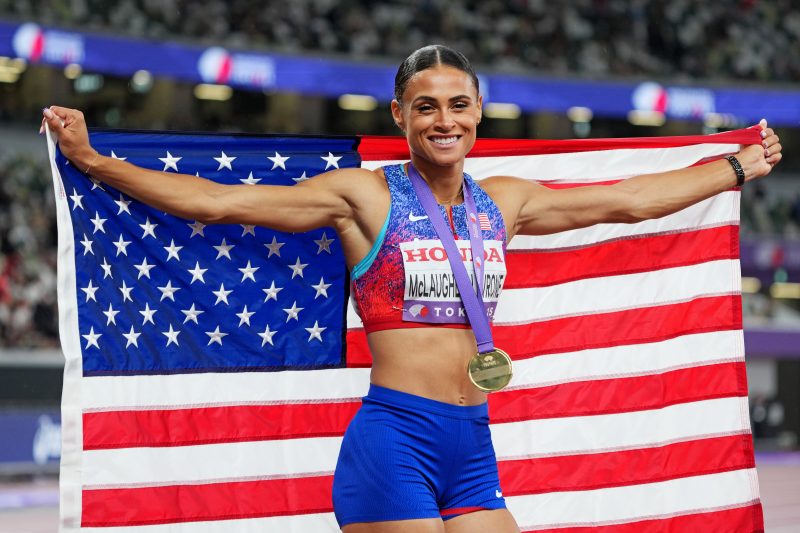
Four-time Olympic track gold medalist Sydney McLaughlin-Levrone is launching a campaign aimed at hypertrophic cardiomyopathy, a disease her father Willie battled for decades.
McLaughlin-Levrone said her dad’s heart transplant forced her to understand when to slow down on and off the track
McLaughlin-Levrone also addressed the possibility of attempting an event double in the 400 hurdles and 400 or 200 flat at the 2028 Olympics.
Sydney McLaughlin-Levrone is finally ready to press pause.
In January, the four-time Olympic gold medalist announced that she is pregnant and expecting her first child with husband Andre Levrone Jr. this summer, which means a break from record chasing – for now.
‘Track and field is taking the backseat in my life for the first time in a long time, which I’m really excited about,’ McLaughlin-Levrone said Tuesday, Jan. 26, in an interview with USA TODAY.
She’ll continue to train while pregnant for as long as she safely can, though competing in the World Athletics Ultimate Championships in September is probably ‘not in the cards’ anymore, she said. Regardless, McLaughlin-Levrone said she is prioritizing a healthy pregnancy and time with her family before her attention turns to preparations for the 2028 Los Angeles Olympics.
The shift also allows McLaughlin-Levrone to focus on launching a new campaign alongside her father, Willie McLaughlin, and Cytokinetics. ‘On Track with HCM’ aims to support patients with hypertrophic cardiomyopathy (HCM), a disease that Willie McLaughlin battled for decades until he received a heart transplant in 2021, months before McLaughlin-Levrone won two gold medals at the Tokyo Games.
‘You want to be there and be able to support and help where you can, and there’s only so much you can do,’ McLaughlin-Levrone said about supporting her dad while training for the Olympics. ‘But I think it was really just being there for him, being present, you know, making sure he knew that we were thinking about him, praying for him, and anything he needed not to hesitate to ask us, because we’re there as family.’
HCM, the most common form of inherited heart disease, is when the heart muscle becomes abnormally thick. The thickened muscle can make it difficult for the heart to pump blood, leading to complications that can cause heart failure or sudden cardiac arrest. It is treatable, but not curable.
Willie McLaughlin was a three-time All-American track star at Manhattan College and a semifinalist in the 400-meter at the 1984 U.S. Olympic Trials. He had no idea he was living with HCM until he was 25 and no longer competing, when an echocardiogram revealed he had a non-obstructive form of HCM.
‘It was a shock, and it was kind of terrifying, to be honest with you, because it brought up a bunch of other issues,’ McLaughlin said. ‘It affects more than just physically: mentally, emotionally, socially, all the other things that go along with it. … Although I had no symptoms, but also it made me think about, what about having kids? What about getting married? How long will I live?’
McLaughlin experienced no symptoms of the disease until he was nearly 40, when shortness of breath, fatigue, arrhythmia and high blood pressure set in. By the time he was in his 50s, he struggled to walk up the subway station steps during his two-hour commute from New Jersey to New York City. When he was 57, he learned he needed a new heart.
McLaughlin said it was challenging and isolating to square his identity as an elite athlete with having a debilitating disease. He didn’t want to worry his family, so he delayed in-depth conversations about his condition with Sydney and her three siblings until he was closer to his heart transplant.
‘Especially being an athlete, you learn to adapt and get comfortable being uncomfortable and pushing through that,’ he said. ‘I kind of sheltered the kids when I probably should have, in hindsight, shared more with them.’
More than half of the 660,000 people living with HCM in the United States are undiagnosed. Some won’t have any symptoms of the disease, while others who are symptomatic may not understand that HCM is the cause. It can be diagnosed through tests such as echocardiograms, electrocardiograms and cardiac MRIs.
People whose family members have HCM are more likely to to have it themselves. McLaughlin-Levrone said she plans to get tested soon.
Throughout her track career, McLaughlin-Levrone has continuously pushed herself outside of her comfort zone, including switching from her main event the 400-meter hurdles to the 400 flat last year. However, she said her father’s ordeal taught her that sometimes it’s also OK – and necessary – to slow down.
‘There has to be a balance of both things,’ she said. ‘Some things just actually need attention and care and rest. And that’s something, whether it’s when my dad was going through things and he needed to just take some time and really recover and give his body what it needed, or even when it comes to the track. My coach tells me all the time, ‘As an athlete, you want to push through, but rest is not a bad word.’’
McLaughlin-Levrone’s quest for an Olympic double
With that balance in mind, McLaughlin-Levrone is taking 2026 step-by-step until she can figure out a post-birth training plan for the next two years.
She said she is still contemplating going for an Olympic double in Los Angeles, though the track and field competition schedule for the 2028 Games might limit her options. In order to attempt a historic sweep of the 400-meter hurdles and 400-meter flat, her top two events, McLaughlin-Levrone would have to run both events in the same day, twice, on July 18 and July 20.
Her backup plan, a double in the 400 hurdles and the 200 flat, would be possible but difficult, requiring races on five consecutive days with the finals of both events scheduled for July 22.
Nevertheless, McLaughlin-Levrone isn’t ruling anything out.
‘I wouldn’t say it’s in the back of my mind. I think it’s always towards the front, to be honest,’ McLaughlin-Levrone said. ‘But yeah, I’m definitely looking ahead towards 2028. That’s definitely on my mind frequently. And you know, we’ll have to, first and foremost, see how pregnancy goes and recovery and coming back. And I’m hopeful that if all that goes well, and training through 2027 also goes well, that maybe there is a world for a double. So, like I said, one day at a time, and hopefully things progress in a positive manner, so that that’s definitely possible.’
McLaughlin-Levrone’s attempted double could give track and field the exposure and hype it so desperately seeks. Although the sport is popular at the Games, it struggles to attract audiences in non-Olympic years. Recently, numerous professional track and field startups have surfaced with varied successes.
Grand Slam Track, a league started by Olympian Michael Johnson, filed for bankruptcy after its inaugural season in December and reportedly owes six-figure sums to multiple athletes including McLaughlin-Levrone. Athlos, a women’s track and field event, concluded its second year in October but is not yet profitable according to its founder. And in fall of 2026, World Athletics, the sport’s international governing body, will introduce a new global competition called the Ultimate Championships which is promoted as having a ‘fan-first format.’
It remains to be seen whether any of these ventures will secure a foothold with fans, or hit the right combination of marketability and profitability.
McLaughlin-Levrone pointed to tennis, with its Grand Slam events featuring high-caliber competition and significant prize money, as a model for track and field to emulate.
‘Obviously, I think the logistics of it, the finances of it, the structures of it, is what’s kind of to be determined, but I’m excited to see there be efforts put forward, especially heading into such a big Games,’ McLaughlin-Levrone said. ‘I think we have so many stars in our sport who want to just be put on display. It’s just a matter of putting the right puzzle pieces together. And we’ve seen efforts of that, and I appreciate that. I’m hopeful that there can be more athlete insight moving forward into how we can actually make these events both marketable for the sport, but also sport-centered, so that it is the stars in their events getting to shine, and that’s going to take some time.’