
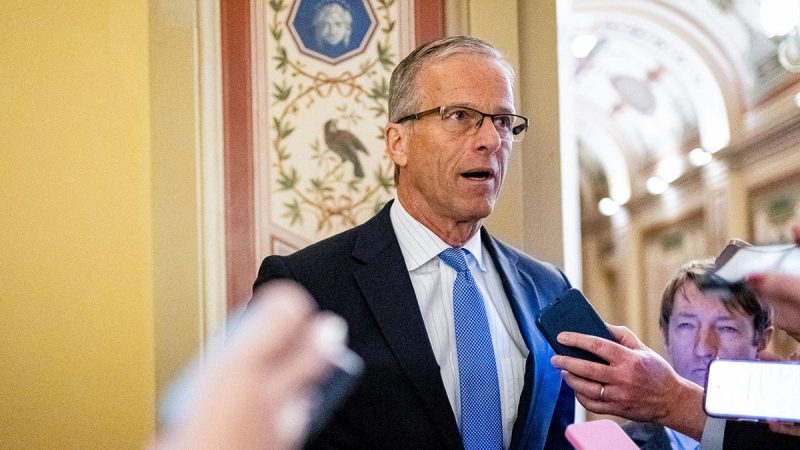
The Senate’s top Republican leader threw cold water on President Donald Trump’s desire to nationalize elections, arguing he was in favor of ‘decentralized, distributed power.’
Trump, during an appearance on former FBI Deputy Director Dan Bongino’s podcast, contended that it was ‘amazing Republicans aren’t tougher’ on elections.
‘The Republicans should say, ‘We want to take over, we should take over the voting in at least many — 15 places,’’ Trump said. ‘The Republicans ought to nationalize the voting. We have states that are so crooked.’
But Senate Majority Leader John Thune, R-S.D., rejected the notion. He said that while he was supportive of only citizens voting and showing identification at polling places to do so, he was not in ‘favor of federalizing elections.’
‘That’s a constitutional issue. You gotta be a citizen to vote in our elections,’ Thune said.
Trump’s ability to morph and shape the election landscape runs into constitutional barriers, notably that elections are run by state and local officials in all 50 states. The federal government has a limited role in that process.
Thune also noted that echoes of the idea were once pushed by congressional Democrats years ago — something that Senate Republicans resoundingly crushed.
‘But there are other things that the Dems had in their proposal to federalize elections which are really bad outcomes for the country,’ he said. ‘I’m a big believer in decentralized, distributed power. And I think, you know, it’s harder to hack 50 election systems than it is to hack one.’
Congressional Republicans strongly pushed back against pushes by their counterparts to pass election reform legislation, notably the John Lewis Voting Rights Act and the For the People Act, which they argued at the time would effectively nationalize elections and give Democrats control of the election system across the country.
Trump’s suggestion came after the FBI raided an election hub in Fulton County, Ga., where federal law enforcement officials were authorized to seize election records, voting rolls and other data tied to the 2020 election.
It also comes as congressional Republicans wrestle with the Safeguarding American Voter Eligibility (SAVE) Act, which previously passed the House but has not gotten a vote in the Senate.
That legislation would require states to obtain proof of citizenship in-person when people register to vote and remove noncitizens from voter rolls. A modified version of the bill gaining steam among conservatives would require photo ID when voting.
Meanwhile, Senate Minority Leader Chuck Schumer, D-N.Y., slammed Trump’s comments and the SAVE Act and affirmed that the bill would never pass through the Senate.
‘Now as for the SAVE Act itself: it has nothing to do with protecting our elections and everything to do with federalizing voter suppression,’ Schumer said. ‘The SAVE Act is nothing more than Jim Crow 2.0.’
Thune rejected the idea, citing constitutional concerns about federalizing elections