
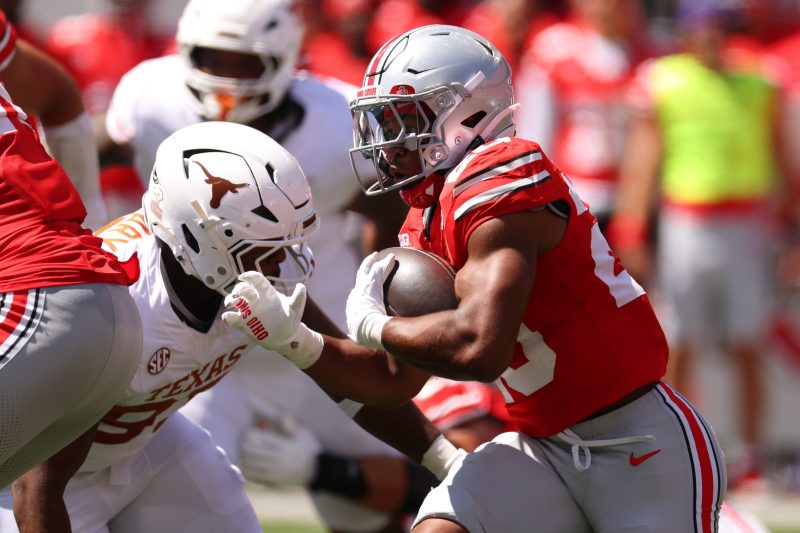
The Big Ten and SEC see this differently than others. They’ve built their brands, they’ve done the heavy lifting. Why share the benefits now?
So let’s break down this thing to its purest form, beyond the white papers and presidential roundtables and putting the toothpaste back into the tube.
What did the presidents and chancellors of the Big Ten and SEC learn from last week’s clown show of a presidential roundtable?
It’s time to go.
Time to pull up stakes, say it was good knowing and competing with everyone else in FBS and FCS, but we’re taking our multibillion dollar product and starting — in the words of Mr. Toothpaste Back In The Tube himself — our own big, beautiful association.
That’s 34 schools from Seattle to Gainesville, Piscataway to Los Angeles, Minneapolis to Austin — and all points between. A true blue national association of the best collegiate sports has to offer.
An association where they’ll make the rules, run the show and make (more) billions doing it.
Hey, when the rubber meets the road, financial sovereignty makes strange bedfellows. Even two superconferences who can’t agree on anything of late.
Speaking Monday on the SEC Network with Paul Finebaum, SEC commissioner Greg Sankey was asked if the SEC would go it alone.
‘How do we work with colleagues to solve problems? Can we do that collectively?’ Sankey said. ‘If there’s a point at which we cannot do so, I think the conversation that informs the question that you ask, ‘Is there something you’d do alone?’ I think that that starts to generate more and more interest.’
It’s not as difficult as you’d think.
The Big Ten and SEC could collectively bargain with players and player representatives, and have stringent player movement rules because they’ll have real player contracts. They’ll have a salary cap, and strict rules against private NIL supplementing player procurement.
The days of he with the most money wins will be long gone.
The first time a school uses illegal private NIL to secure a player, they’re eliminated from the postseason for two years. The second time: They’re out the association.
This is no time to fool around with those who flout rules or push the envelope. This is a multibillion dollar business with more than 100 other schools begging for their ticket to the show.
It’s much easier to kick out a school for blatant disregard of association rules than it is because they’re fortunate enough to have been part of the SEC or Big Ten when they were formed.
This won’t be just a football move. The SEC and Big Ten can play each other exclusively in all sports, from football to basketball and baseball, and all Olympic sports. No more creampuffs, no more guarantee games.
They’ll have their own football playoff, basketball tournaments and baseball and softball playoffs. And make an absolute financial killing.
A television and streaming rights bonanza the likes of which collegiate sports has never seen. If you think college sports could get 50% more by pooling its media rights among all 10 FBS conferences — that’s the projection by those pushing the idea — imagine what a Big Ten/SEC association will fetch.
This is where we are, OK? It doesn’t matter how we got here, or that the Big Ten and SEC are as much at fault as anyone for college sports unraveling into a financial and player movement free-for-all.
This is about money.
It’s not about player movement (though that’s a critical component), or exorbitant coaching buyouts or a lack of rules enforcement. And it’s certainly not about academics.
This is about staying ahead of two massively mistaken moves made by two conferences that should’ve known better. Two moves that led to generational instability in collegiate sports, and now have the President of the United States and Congress involved in their business.
The irony of it all is this: The presidents and chancellors of the Big Ten and SEC made expansion moves five years ago based on a cash-grab philosophy. Now they’re fighting to not give it away.
In a perfect world where the leaders of academia spoke and wanted the best for all, the SEC presidents and chancellors would’ve reached out to their counterparts at the Big Ten when Texas and Oklahoma decided they wanted to leave the Big 12.
In a perfect world, one (or preferably more) of those then 28 presidents and chancellors of the Big Ten and SEC would’ve had the foresight to see a chain reaction of expansion moves dangerous to the health and welfare of the collective. You know, like the last one a mere decade earlier that eliminated the Big East.
Someone, anyone, saying we’re on the verge of eating another power conference ― so neither the SEC nor the Big Ten are taking Texas and Oklahoma, thank you. Or we’re standing on the precipice of paradigm change so drastic, we won’t recognize what we’ve done until we’re sitting at the White House and the leader of the free world’s answer to the madness we’ve created by our own sins and souls is, “let’s go back to the old way.”
Now the only answer is to break away and form their own association.
Because these two titans of collegiate sports, these two money-making machines, aren’t going to supplement the rest of college sports. No matter how you look at pooled revenue sharing — even if it guarantees the SEC and Big Ten won’t lose money — it’s still watering down their products by eliminating some (not all) of their prime Saturday TV windows.
And, of course, eliminating any chance of individual financial growth.
The Big Ten and SEC see this differently than others. They’ve built their brands, they’ve done the heavy lifting. Why share the benefits now?
It’s time to go.
If you don’t think the SEC and Big Ten will make such a drastic move, you’re the same person trying to shove the toothpaste back in the tube.