
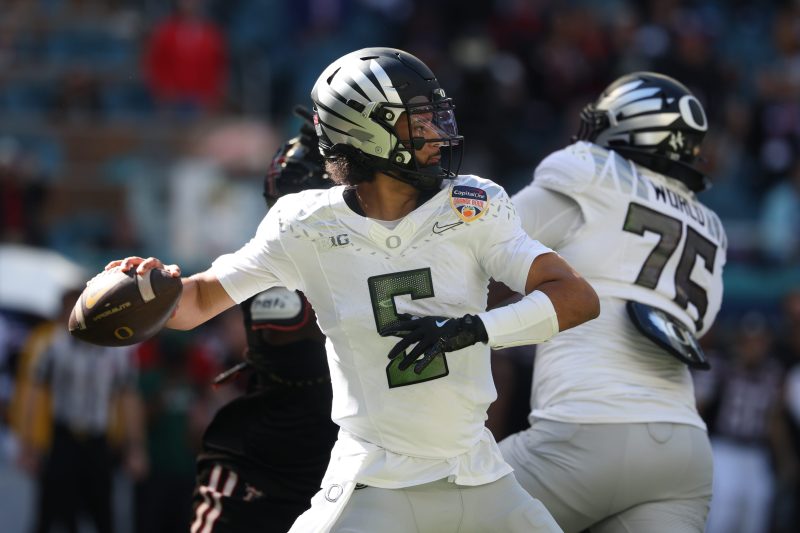
Wednesday, Moore announced he’ll forego the 2026 NFL Draft in order to play another season for the Ducks – in what’s very likely the best decision for him … and the New York Jets.
Moore, who’s started just 20 games in college – 15 in Oregon’s just completed season and five for UCLA in 2023 – was widely projected to be a top-five pick in this year’s draft, quite possibly second overall to the quarterback-starved Jets. (The Las Vegas Raiders are expected to take Indiana star and recently crowned Heisman Trophy-winning QB Fernando Mendoza in the top spot.)
Still, some NFL scouts believe Moore could have more professional upside than Mendoza.
“Around the league, there’s a debate on who’s one or who’s two,” ESPN draft analyst Matt Miller recently told USA TODAY Sports. “Some people love Mendoza – pocket passer, super accurate, poised, never seems to get rattled. He’s more of a distributor – he allows his guys to go make plays. I think there’s a lot of people that see that and like it. He’s kind of Jared Goff-esque … or Kirk Cousins-plus.
“Dante, I think he’s a little more explosive, he’s a little more dynamic. … He’s really not quite as experienced. And so it’s more of an upside bet.”
Mendoza thoroughly outplayed Moore in last Friday’s Peach Bowl, the Hoosiers scalding the Ducks 56-22. Mendoza’s performance, which included five touchdown passes and three incompletions, aligned with Miller’s description of him. However Moore threw an ugly pick-six on the first play from scrimmage, didn’t deal with Indiana’s defensive pressure effectively and – despite a promising second drive capped by a 19-yard TD pass to Jamari Johnson – wasn’t able to keep Oregon competitive in the CFP semifinal round, his 285 passing yards largely cosmetic.
The game was but a snapshot of Moore, who was third-team All-Big Ten 2025 and typically has a strong and accurate arm, and hardly a microcosm of his breakout season. Yet it was also more indicative of what he’ll see on an Sundays than a Saturday in Eugene or Corvallis.
Moore’s decision likely spares the perpetually rebuilding Jets – and a roster that began getting stripped of talent at November’s trade deadline – from a mistake. Though the NYJ touted the consistency of their offensive line at the end of the season, which they ended by losing a record five consecutive games by at least 23 points apiece, they hardly have the look of a team that’s one young quarterback away from competing. And for a franchise that’s failed to support and/or develop Mark Sanchez, Geno Smith, Sam Darnold, Zach Wilson and Justin Fields – and that’s just over the past 15 years – asking Moore to deliver in the pressure cooker that is the New York market without a reputable QB sensei would have been a highly suspect decision.
Also, the NFL has done no favors to inexperienced passers taken as top-five picks in recent years – think Mitch Trubisky, Trey Lance or Anthony Richardson.
So while Moore returns to school in hopes of further polishing his game – and, make no mistake, it’s a decision quite likely to cost him significant draft position (and money) in the 2027 draft, though could ultimately render him a better football player – where do the Jets go from here?
Here are four suggestions for Gang Green:
Bring in a veteran QB with upside
Hard to imagine Fields is sticking around for the second year of the deal he signed last year – especially given his ongoing inability to develop as a passer, and offensive coordinator Tanner Engstrand’s inability to consistently deploy the dual threat in a way that leverages Fields’ talents as a runner.
As is typically the case, the crop of free agent quarterbacks is going to be thin. Kenny Pickett, Sam Howell and Malik Willis – and he might actually have a fairly robust market – seem like the best options (and, no, we’re not advocating for Daniel Jones to return to New York).
Even though he’ll be 38 next season, maybe Cousins could be a temporary option – given the relative strength of the Jets’ line and his desire to remain a starter in the league, even if only in a bridge capacity. He’s certainly closer to Jared Goff, whom Engstrand worked with in Detroit, than anyone else on this list. And the rebooting Falcons could more easily trade Cousins now from a salary cap perspective – though they might be compelled to retain him as Michael Penix Jr. recovers from his most recent knee injury.
But maybe the sweet spot solution is Mac Jones. A failed 2021 first-rounder alongside Wilson, Lance and Fields, Jones – like Darnold before him – has seemingly benefited from a year in Kyle Shanahan’s quarterback halfway house with the San Francisco 49ers, winning five of eight starts this season while crafting a career-best 97.4 passer rating. Jones is a fiery competitor and has a demeanor teammates tend to gravitate toward. And as flush with draft capital as the Jets are after offloading Quinnen Williams and Sauce Gardner in November, sending, say, a third-rounder to the Niners for Jones, who’s already under contract for 2026, could be a worthwhile gambit.
Draft a quarterback … but not early
The Jets have two first-round picks this year. They should use both with the always prudent “best player available” approach in mind to build out this roster. And unless the Raiders pass on Mendoza for some hard-to-fathom reason, that means the NYJ should be steering clear of QBs on Day 1 of the draft. The Jets also possess two second-round picks. But even then, using one on Alabama’s Ty Simpson, for example, seems misguided given his own limitations. But if Simpson or LSU’s Garrett Nussmeier or Clemson’s Cade Klubnik, for example, are available in the middle rounds, any might be worth a flier given their upside and the general lack of expectations they’d carry forward from college at this point.
Draft a playmaker … early
Even if the Jets have no business taking a QB with the second pick, laying the groundwork for the eventual face of the franchise makes sense. WR Garrett Wilson and TE Mason Taylor, a second-round pick by this regime last year, could be the start of a nice suite of weapons.
But the Jets have probably over-targeted and overburdened the wispy Wilson in recent years – and he only played in seven games in 2025. Taking another Ohio State receiver, Carnell Tate – perhaps a similar, if slightly bigger (6-3, 195) version of Wilson – could be the right play. Buckeyes pass catchers translate very well to the NFL, and creating a tandem that could be a nice 1/1A combo would be sensible.
And though it’s quite lofty for his position, perhaps lengthy consideration should be given to Notre Dame RB Jeremiyah Love. The caveat is having a plan here – not tossing him into an unfortunate situation like the one Las Vegas’ Ashton Jeanty found himself in as a rookie. But remember, this offense – at least based on how it operates in Detroit – heavily relies on two backs, and the Jets may not have one frontliner if Breece Hall jets in free agency. Regardless, the dynamic Love might be perfectly utilized in some kind of time-share here, especially since his skills as a receiver would absolutely benefit any kind of quarterback − but especially a young one.
Keep the phone lines open
Are the Jets likely to field an offer at No. 2 the way the Cleveland Browns did last year, when they traded down so the Jacksonville Jaguars could reel in Heisman Trophy winning WR/CB Travis Hunter? Seems rather unlikely – especially in a draft so seemingly devoid of quarterback talent. But if the Jets can move out of the second spot – even if it means taking a bit less than a premium package – to slide back a handful of spots, they should. They have too many needs, especially defensively, to stick and pick in this draft unless they’re absolutely convicted about someone like Love or a defender such as Buckeyes pass rusher Arvell Reese. But given the obvious signal the team sent that it’s embarking on a lengthy rebuild, stockpiling assets – especially if that means extra ammo in what’s expected to be a loaded 2027 draft – seems like the chess move for GM Darren Mougey and coach Aaron Glenn.