
A pair of very good baseball players earned election to the sport’s Hall of Fame Jan. 20, when Carlos Beltrán and Andruw Jones became just the seventh and eighth center fielders to win a spot in Cooperstown.
While neither are generational and the lone title won by either man in their collective 37 seasons was Beltrán’s 2017 title when he was a part-time 40-year-old DH and full-time illegal sign-stealing mastermind for the Houston Astros, their July inductions will be proof that gains can be made and early deficits overcome in voting.
Perhaps that will offer solace to those lurking a little further down the 2026 ballot. With that, a look at the winners and losers from 2026 Hall of Fame balloting:
Winners
Carlos Beltrán
Any notion that his role in the Astros’ sign-stealing scandal might ding his Hall candidacy was ludicrous, given the widespread Wild West atmosphere of high-tech cheating across the major leagues at that time.
No, Beltrán got in on his fourth try, a nice reward for a guy who broke in playing for some overmatched Kansas City Royals teams and finished it as a highly productive veteran bat in places like New York, St. Louis and Texas. Hopefully the Hall call will reopen the door to the manager’s office for a great baseball mind (and yes, one of its elite sign-stealers, legal or otherwise).
Andruw Jones
Proof that professional life can end at 30 and everything turns out all right.
A phenom in the truest sense of the word, Jones remains the lone two-time winner of USA TODAY Sports’ Minor League Player of the Year Award. At first glance, it might seem like the kind of honor you wouldn’t want to win twice, like a return invite to the Futures Game. Then you realize he was 18 and 19 years old when he got those nods, then hit two World Series Game 1 home runs in the latter year, and it makes a lot more sense.
He never really lost that glow throughout his 20s, but after an anomalous 51-homer year in 2005, it all went south for the lad, as he drifted from Atlanta to Los Angeles (the Dodgers eating the second year of his contract) to Texas, the White Sox and finally the Yankees, and he was out of the game by 35.
Perhaps that bad taste in the mouth lingered early on for voters as he was named on just 7.3% of ballots in his first year, narrowly clearing the 5% necessary to stick around. Eventually, the vision of the otherworldly kid prevailed in voters’ minds.
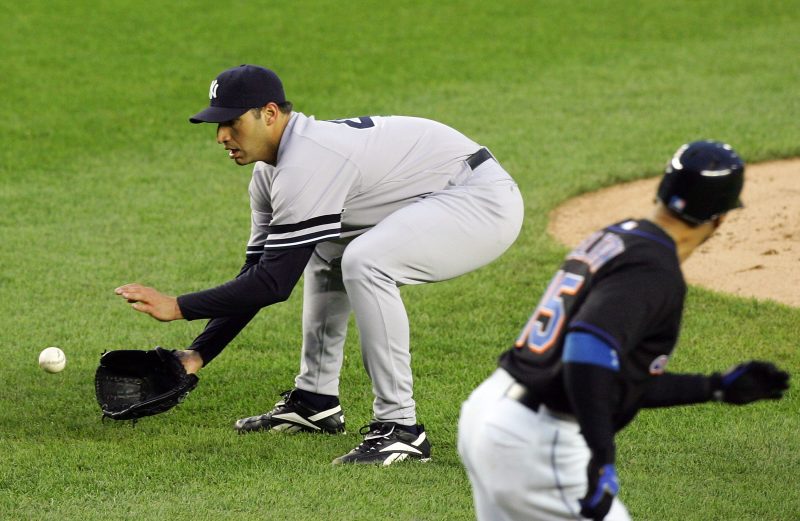
Andy Pettitte
The admitted user of PEDs has upped his vote share to 48.5%, which would be remarkable on its own. Then you realize his 3.85 career ERA would be the highest among pitchers elected by the BBWAA and second highest of any, better only than Jack Morris’s 3.90 mark.
Adjusted ERA treats Pettitte a little better, as his 117 mark puts him behind 87% of electees, in the Gaylord Perry-Phil Niekro compiler rent district.
Sometimes, timing is everything. Pettitte has stuck around long enough that younger voters were likely in their teens when the Mitchell Report was released, and grammar school when Pettitte was admittedly doping. Yet even older heads such as Bob Costas are succumbing to Pettitte lust, as he said during the Jan. 20 Hall broadcast, “He says he only took HGH, and for an injury, and I believe him.”
Goodness, never heard that line before.
Losers
Manny Ramírez
Speaking of steroid guys, Manny is now off the writers’ ballot after eliciting votes from 38.8% of electors. There’s a credible case to be made that Ramírez put together something of a Hall-worthy career before he was connected in any fashion to PEDs, but running afoul of MLB’s secret police tends to sour voters further.
If Barry Bonds is any indication, Ramírez – a man with 555 home runs, two World Series titles and a dozen All-Star nods – won’t fare any better with the Eras Committee codgers.
Batting average
The stat was probably always overrated and then took perhaps a harsher beating than it deserved, not unlike the public perception of Leonardo DiCaprio’s filmography, say.
And Jones’ election is another blow to the measure of whether a player can, you know, actually hit.
Jones’ career average was .254, placing him 217th among Hall of Famers and closer to many pitchers than the .302 mark for the average batting electee.
You say that’s not so bad, huh? Well, consider that Jones’ peak years played out in one of baseball’s most offensively aroused eras. In 2001, as Barry Bonds was hitting 73 home runs, Jones was batting .251 – or, 13 points below the .264 league average. That’d be like an All-Star ostensibly in his prime today hitting .231.
Sure, Jones’ power and defense and WAR and all the rest makes him plenty valuable and, as a narrow margin of voters determined, worthy of Hall of Fame induction. Eras evolve, standards vary and admission prices will change.
Still, it’d be nice to think that a Hall of Fame position player can, you know, hit a little.
Ryan Braun
A former MVP whose 47.7 WAR puts him in a Hall of Fame rent district with Jim Rice and Orlando Cepeda, Braun dropped off the ballot entirely, getting just 15 votes and 3.5%, shy of the 5% needed to stick around.
Alas, while Braun beat the rap when he tested positive during the 2011-12 off-season, his hectoring of a urine sample collector in his defense and ultimate ensaring in the Biogenesis game caught up to him. Once again, how voters will interpret the “integrity, sportsmanship and character” elements in balloting can be unpredictable.