
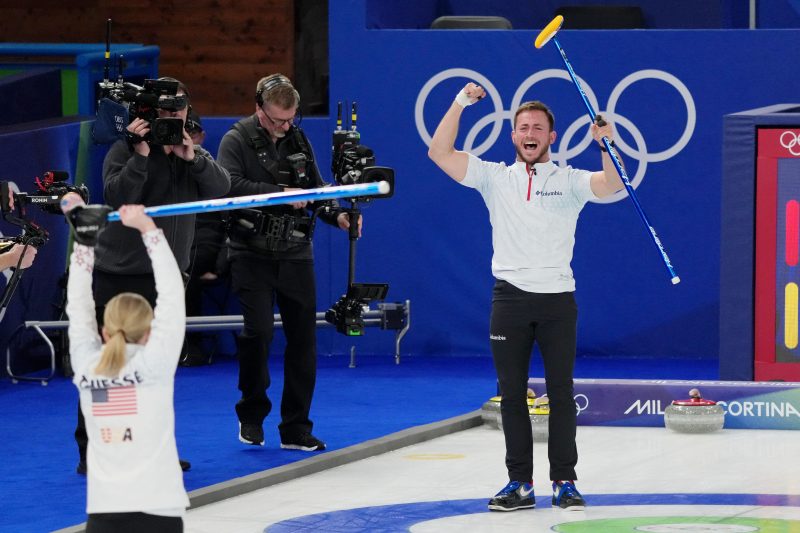
CORTINA D’AMPEZZO, Italy – Rich Ruohonen, 54, remembers when curlers smoked cigarettes on the ice.
“All we did was throw rocks and think we could be better,” he said.
That was a few decades ago, when the oldest American Winter Olympian first started throwing and sweeping stones in Minnesota. Today, curlers rebuff their longstanding reputation as dads with brooms and the bods to match by embracing gym-rat status. The proof is in their clingy jerseys.
Mixed doubles silver medalist Korey Dropkin got catcalled during Team USA’s final game against Sweden. “Show us your biceps!” someone in the stands cried. Dropkin smiled and flexed in their direction.
Not the purpose of Dropkin’s workout regiment, but surely an added bonus for viewers so inclined.
Fitness has become an important aspect of curling over the last decade. It’s especially crucial for sweepers, who pump brooms across the ice to influence a stone’s path to the house. Curling is a game of inches. Millimeters even. So whatever those athletes can do for the most marginal edge, they will. And fitness is part of that.
“If you don’t look like these guys, this guy in particular,” Ruohonen said, gesturing at front-end player Aidan Oldenburg, “and Korey Dropkin, you aren’t going to win at this level anymore. And you’ll see it in these guys. Every one of them is ripped, and every one of them sweeps their butt off.”
Dropkin is proud to be known as the buff curler who huffs and puffs his way down the ice, sweeping whatever stone his mixed doubles teammate Cory Thiesse threw toward the button.
“Curling isn’t thought to be a very physical sport, and what I’ve really enjoyed is kind of trying to turn the thought process of that,’ Dropkin said. ‘I want to be able to display and demonstrate how physically demanding the sport is, especially the sport of mixed doubles curling.”
Think about it. A stone is thrown, and the sweeper can spend 20-25 seconds clearing its path of tiny bumps on the ice. That work, Dropkin said, can elevate one’s heart rate from double-digit resting to 170 or 180 beats per minute.
Then it’s time to slide or walk to the opposite end of the sheet. Before the next stone is thrown, that heart rate has to fall below 120 again. Or else sacrifices are being made to the precision of the next stone.
“It’s really a high intensity interval workout,” Dropkin told USA Today, “and that’s how I train.”
During the offseason, Dropkin and Oldenburg said the men of USA Curling lift weights about four days a week. Full-body workouts are the focus. They build strength from the legs to the core to the upper body, so curling for a full week at a high level is doable.
Dropkin adds three days of cardio or HIIT (high-intensity interval training) workouts to that. “Just to make sure that I’m covering all my bases,” he said.
That’s a far cry from the early days of the sport.
Ruohonen’s first Olympic Trials was 1988. Cortina is his first Winter Games.
“I think the physical aspect hasn’t changed across my career as much as it has across Rich’s career,” Oldenburg said, poking fun at his older teammate, “but for me, as a front-end player, sweeping is one of the biggest parts of the game. … The front-end players, they’re all athletes now.
“… There’s so much that we can do with sweeping now. We can make the rocks curl a little bit extra, carry the rocks further, and it affects so much. It allows us to be that… 1-2% better as a team.”
Reach USA TODAY Network sports reporter Payton Titus at ptitus@gannett.com, and follow her on X @petitus25.